How to Charge a Camping Battery Safely
A flat camp battery can turn a good weekend away into warm drinks, dark tents and a fridge full of spoiled food. Knowing how to charge a camping battery properly means your 12V setup is ready for the next coastal run, bush camp or caravan holiday - without shortening the battery’s life along the way.
The right charging method depends on the battery chemistry, where you are and how quickly you need power back. An AGM battery in a battery box needs different settings from a lithium battery, and a solar panel that works brilliantly in full sun may barely keep up beneath heavy tree cover. Start with the battery label, use a charger designed for that type, and give charging the same attention you give packing recovery gear or checking the tyre pressures.
Know your camping battery before charging
Most camping setups use a deep-cycle battery. Unlike a normal vehicle starter battery, a deep-cycle battery is built to deliver steady power over a longer period for appliances such as fridges, camp lights, water pumps and mobile chargers.
The two common types are AGM or lead-acid batteries and lithium iron phosphate batteries, often marked LiFePO4. They charge differently. Lithium batteries generally recharge faster, weigh less and can be discharged further, but they need a compatible lithium charging profile. AGM batteries are usually more affordable upfront and widely used in battery boxes and caravans, but they are heavier and should not be deeply discharged as often.
Check three things before connecting anything: the battery voltage, its capacity in amp hours (Ah), and its recommended charge settings. A 12V 100Ah AGM battery and a 12V 100Ah lithium battery may look similar in a battery box, yet using the wrong charger mode can reduce performance or trigger a battery management system shut-off.
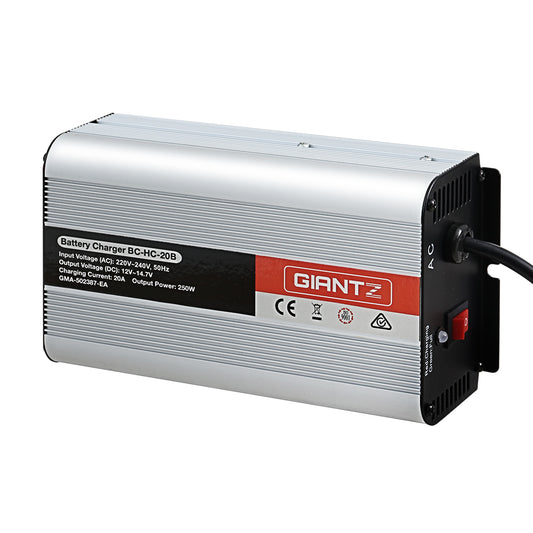
How to charge a camping battery with a 240V charger
Charging from mains power before you leave is usually the simplest and most reliable option. A quality smart charger monitors the battery and moves through charging stages automatically, reducing its output once the battery is full. Use a charger recommended or specified for the battery and follow the charger and battery manufacturer instructions.
Park the battery in a dry, well-ventilated spot away from flames, sparks and direct heat. AGM and other lead-acid batteries can release gas if they are faulty or overcharged, so do not charge them in a sealed tent, vehicle cabin or tiny storage cupboard. Lithium batteries do not vent in normal use, but they still need sensible handling and should never be charged if swollen, damaged or excessively hot.
With the charger switched off and unplugged, connect the positive red clamp to the positive battery terminal first. Then connect the negative black clamp to the negative terminal. Select the correct battery mode - AGM, lead-acid, calcium or lithium - before switching the charger on at the wall.
A charger rated around 10A is a practical all-round choice for many 100Ah camp batteries. It will take roughly 10 to 12 hours to replenish a heavily used 100Ah battery in ideal conditions, though charging losses and the final absorption stage can make it longer. A 20A charger is quicker, provided the battery manufacturer allows that charge rate. Faster is not automatically better if it creates excess heat or exceeds the battery’s recommended limit.
Once the charger indicates the battery is full, switch it off at the wall, disconnect the negative lead, then remove the positive lead. If you are storing the battery for weeks between trips, a smart charger with a maintenance or float mode can help keep an AGM battery healthy. For lithium, follow the maker’s storage advice rather than leaving it permanently on charge.
Charging a camping battery while driving
A battery connected directly to your vehicle’s alternator may receive some charge while you drive, but modern vehicles make this less reliable than it sounds. Smart alternators often reduce voltage once the starter battery is charged, leaving your auxiliary battery undercharged.
A DC-DC charger solves this problem. It takes power from the vehicle and delivers the correct multi-stage charging profile to the camping battery. It is the best option for regular road trips, 4WD touring and caravan travel, particularly where the battery sits in the rear of the vehicle or trailer and cable voltage drop is a factor.
Choose a DC-DC charger sized to suit both your battery and your driving habits. A 20A unit may be enough for light users who drive several hours between camps. If you run a larger fridge, camp for longer, or want to recover power more quickly, a 25A or 40A setup may make more sense. Your cabling, fuses and connectors must also be rated for the system. A bigger charger on undersized cable is not a shortcut - it is a heat and reliability problem.
Remember that alternator charging only works while the engine is running. Avoid idling the vehicle just to charge a battery. It is inefficient, burns fuel and is not great for the engine or the campsite atmosphere.
Use solar to stay off-grid for longer
Solar is ideal for topping up a camping battery when you are set up in one spot. A fixed panel on a caravan roof is convenient while travelling, while a portable folding panel can be angled towards the sun after you arrive. Portable panels also let you park the vehicle in shade while placing the panel out in the open.
Every solar setup needs a regulator between the panel and battery. The regulator controls voltage and current so the battery receives a suitable charge. As with mains chargers, choose a regulator with the correct AGM or lithium setting. An MPPT regulator generally gets more from the panel than a basic PWM regulator, especially when sunlight is weak or panel voltage is higher.
Panel output changes all day. A 200W panel will not necessarily produce 200W continuously, and cloud, shade, dust, poor panel angle and hot conditions all reduce output. As a rough real-world guide, a 200W solar panel can often produce enough energy on a clear day to cover the typical use of an efficient 40L to 60L compressor fridge, plus lights and device charging. It may not fully recover a deeply discharged battery after a run of cloudy days.
Keep panels clean, face them towards the strongest sun where practical, and shift portable panels as the sun moves. Never leave a portable panel where it can be driven over, blown into a fire pit or become a trip hazard around camp.
Avoid the mistakes that kill camping batteries
Most battery failures are preventable. The common issue is repeatedly running a battery too low, then leaving it flat for days or weeks. Lead-acid batteries suffer badly from this and can lose capacity permanently. Lithium batteries cope better with deeper discharge, but their battery management system may disconnect the output when voltage gets too low.
Use a battery monitor or at least a voltmeter rather than guessing. Voltage is only a rough indication of charge, particularly when a battery is under load, but it is still better than waiting for the fridge to cut out. A proper shunt-style monitor is useful for longer trips because it tracks energy going in and out of the battery.
Also avoid these four common problems:
- Using a charger without the correct battery chemistry setting.
- Charging a damaged, swollen, leaking or hot battery.
- Connecting clamps backwards or using loose, corroded terminals.
- Running high-draw gear such as an inverter, kettle or compressor beyond the battery and cable ratings.
How often should you recharge it?
Recharge after every trip rather than putting the battery away partly discharged. For AGM batteries, that habit makes a major difference to service life. If the battery is used occasionally, check it every month or two during storage and top it up if needed.
Lithium batteries are less fussy about being kept at 100 per cent, and many manufacturers recommend storing them partly charged for long periods. Do not charge a lithium battery below its permitted temperature range. Some batteries have low-temperature charge protection, but not all do - a frosty High Country morning is worth checking twice.
Before heading off, test the full system at home: battery, charger, fridge lead, solar input, Anderson plugs and any 12V sockets. It takes ten minutes on the driveway and can save a long detour when you are already halfway to camp.
A well-charged battery is not glamorous gear, but it is what keeps the practical comforts working after sunset. Set up the right charger, match it to your battery, and you will spend more time around the campfire and less time chasing power.
Battery charging safety matters
Do not charge a swollen, leaking, excessively hot or otherwise damaged lithium battery. Keep lithium batteries cool, dry and out of direct sunlight, charge on a non-flammable surface where practical and use only a compatible charger recommended for the battery. Fixed 240V electrical installation or repair work should be carried out by an appropriately licensed electrician; do not DIY mains electrical work.
Browse 12V batteries and chargers once you know the battery chemistry and charging method your setup requires.